I keep a spreadsheet that started as a receipt and turned into an argument, because when people ask whether self-hosting saves money I wanted to answer with numbers instead of vibes, and the numbers turned out to be more interesting than either of us expected. This blog has spent a year replacing services one at a time, Bitly and Calendly and Zapier and Netflix and Spotify and Audible and Dropbox and Google Photos, each post with its own price shock, and the question I never answered properly is the cumulative one, what did all of it use to cost, what does it cost now, and what did I leave out of the first number every time someone told me self-hosting was free.
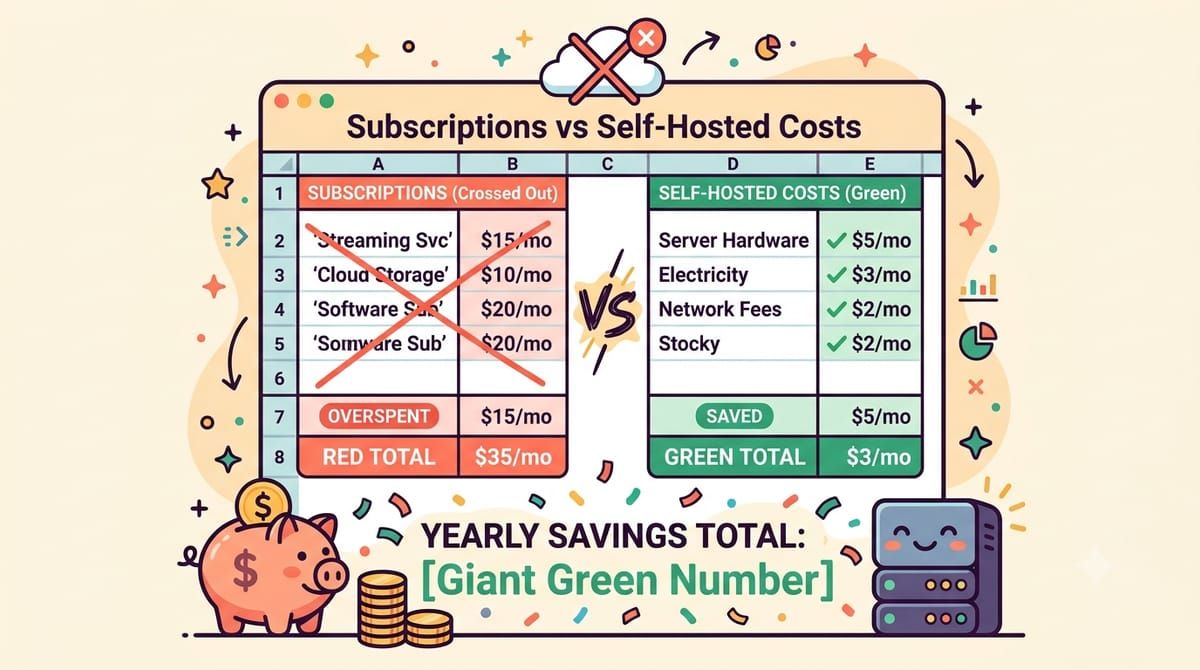
The replaced column first, and this is the part people underestimate, because the savings do not arrive as one large subscription, they arrive as twenty small ones that never appear on the same statement. Netflix and Spotify were the visible ones at around eight hundred rupees a month together, Google Photos sat inside a storage plan at two hundred, Dropbox was another two hundred for the files Syncthing now carries, Audible took two hundred a month for books I did not own, and then the infrastructure tier that hides in business accounts, Bitly at forty dollars a month, Calendly at sixteen, Zapier at seventy-four before I stopped opening the invoices, Slack at five hundred dollars a year for a team of four, Google Workspace for the email, and the VPS I was renting at sixty dollars a month to host what a two-hundred-dollar computer now hosts. Added honestly, the old stack cost me somewhere north of forty-five thousand rupees a year, and I want to be clear that this is the modest version, because a household with a Plex habit and a Ring subscription and a family of photo-takers replaces more than I did.
The new column has more lines than the marketing would have you believe, so let me count them all rather than the flattering ones. The hardware was twenty thousand rupees for the ITX box and another six for the two-bay disk shelf and the second drive that mirrors the first, amortized over five years because hardware dies eventually and honesty means pretending it will, which lands near five thousand a year. Electricity is the line I argued with myself about, a server idling around fifteen watts with the disks sleeping draws about a hundred and thirty units a year, which at my tariff is under a thousand rupees, and the efficient used desktop I recommended in the hardware post actually dropped that number. The domain is nine hundred a year, the internet connection was already in the budget because I was streaming Netflix over it anyway, and the Backblaze offsite copy of the backups is the one real recurring cost at roughly a hundred rupees a month for the data I actually keep offsite. Total, somewhere around seven thousand rupees a year, which makes the spreadsheet say I am ahead by about thirty-eight thousand annually, and the spreadsheet is technically correct and morally incomplete.
The incomplete parts are the ones worth writing down. Self-hosting costs time, and time is money only in the sense that nobody has ever paid me for either, the migration weekends and the debugging evenings and the morning I spent restoring from backup to prove the backups work are real costs that never appear on a receipt, and I would be lying if I priced them at zero, though I will note that some of those hours were the most entertaining of my year, which is a discount rate no subscription has ever offered me. There are costs I dodged by choosing well, Immich replaced Google Photos without a fee, but the disk to hold a photo library is real and I counted it, and there are services I deliberately did not replace because the math failed, I still pay for one streaming service for the content I cannot reasonably host, because owning a DVD rack in 2026 is a personality and I only have so much personality.
What the spreadsheet cannot hold is the other return, the one that keeps me doing this even in years when the savings are smaller. The subscriptions were rent, and rent bought a place where the landlord could raise the price, remove a feature, train a model on my photos or shut the doors entirely, and every one of those things happened to at least one service on my old list. What I own now cannot reprice, the files sit on hardware in my cupboard, the exit is a folder I can copy, and the skills compound in a way that a monthly fee never did, because the person who set up a reverse proxy once can set up anything next.
So the honest answer to whether self-hosting saves money is yes, by roughly the price of a decent phone every year, with the fine print that the first year pays for hardware and the real dividend is not money at all. The spreadsheet is up to date again this month, and the argument it makes is quieter than the ones on the internet but it has numbers in it, which in my house is how arguments are won.
If you want more posts about the real cost of owning your stack, subscribe to the newsletter.