I have been thinking a lot about where my data actually lives. Not in the abstract sense of cloud storage or server locations but in the real gut-level feeling of knowing that every email I write, every photo I take, every document I edit passes through someone else’s computer before it reaches mine. I used to think this was just how things worked, the price of living in a connected world where convenience matters more than ownership. But lately I have been questioning that trade-off more and more, especially after watching service after service change their terms, raise their prices, or simply decide that my data was theirs to use however they saw fit.
The average person’s digital life in 2025 was scattered across thirty or more cloud services and I was no exception. Google had my emails and my photos and my location history and my search history and probably inferences about my health and my relationships and my political leanings that I had never explicitly told anyone. Apple had my messages and my backups and my device locations. Meta had my social graph and my interests and my browsing habits from every site that embeds a Like button or a tracking pixel. OpenAI had my conversations from every prompt I typed while experimenting with the latest models. Each one of these companies built a profile of me more detailed than anything I could construct myself, and the only thing I got in return was the ability to use their software for free or for a modest monthly fee that somehow never seemed to go down.
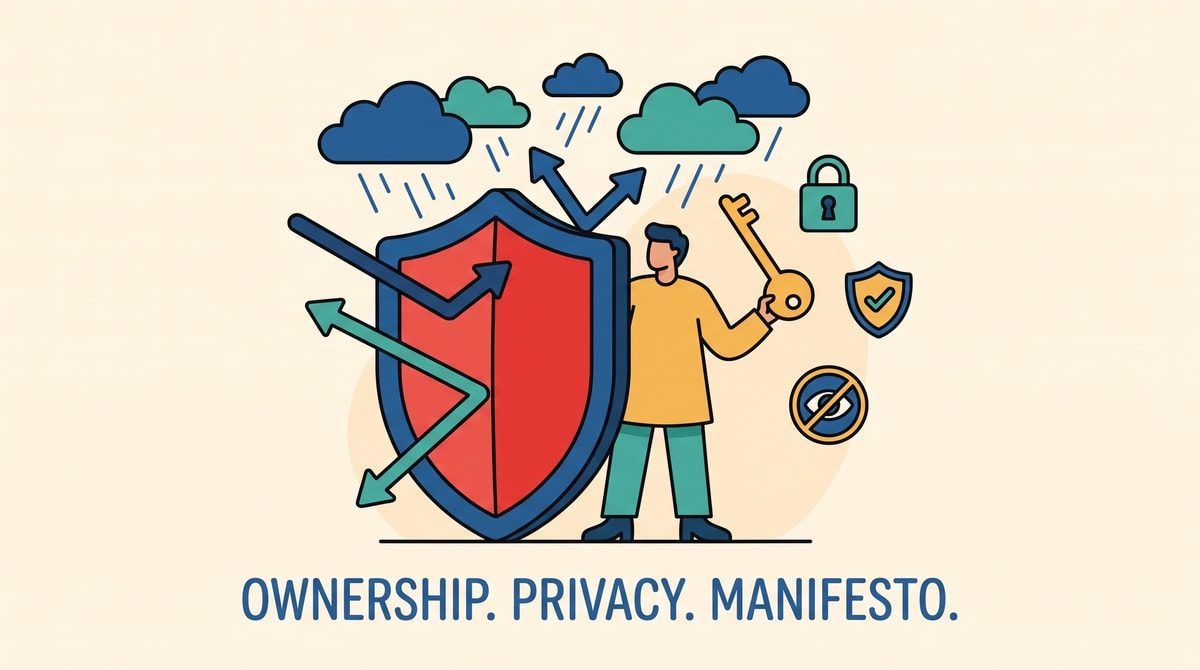
Self-hosting flips that whole model on its head. You own the server so you own the data and you own the decisions about what happens to it. Nobody can change the terms of service on your own hardware. Nobody can decide that your photos are now fair game for training their AI. Nobody can deprecate the product you depend on because they want to redirect resources to something more profitable. When you run your own services the relationship between you and your software is direct, not mediated by a corporation’s quarterly earnings report or a product manager’s OKRs.
The thing about cloud services that people do not talk about enough is how fragile your access to your own data really is. Google can deprecate your favorite service and they have done this many times over the years, killing products that millions of people relied on because they did not hit some internal revenue target. Dropbox can change its pricing overnight and suddenly your grandfathered free plan is gone. Twitter can destroy a decade of third-party tooling with a single API policy change. When you depend on these platforms you are not a customer, you are a tenant living in someone else’s building under terms that can change with a thirty-day notice.
Every cloud service has a data retention policy which is to say they keep everything they can, for as long as they can, because data is their raw material. Even if you trust the current leadership of a company, a data breach or acquisition or leadership change can upend everything overnight. We have seen this happen so many times that it should no longer surprise us. Self-hosted services keep your data on your hardware encrypted with your keys, and the only person who can change that arrangement is you.
The cost argument is the one that gets people in the door. A small ITX PC running at home can replace Google Workspace and Dropbox and a password manager and a calendar service and a media server and more. The math is not subtle. I was paying close to sixty dollars a month for various subscriptions before I started self-hosting, and now I pay just the electricity to run a machine I already own. But the real savings are not just financial. The real saving is knowing that none of these services can hold my data hostage if I decide to switch providers or change my setup.
Two things make 2026 genuinely different from previous years when people talked about self-hosting. Hardware has gotten so cheap that it is almost absurd. You can build a Mini ITX machine with a refurbished 8th gen Intel i3 processor and 32 gigs of RAM for under two hundred dollars, or you can run everything on a thirty-five-dollar Raspberry Pi 5 that sips power and sits silently on a shelf. I have a refurbished i3 8th gen in an ITX cabinet sitting in my closet that cost me under two hundred dollars and runs twenty Docker containers without breaking a sweat. Compare that to what I was paying per year for cloud subscriptions and the thing paid for itself in three months.
The software has matured too. Self-hosting used to mean fighting with config files and chasing dependency hell and spending hours on forums trying to figure out why something would not start. Now tools like Umbrel and CasaOS give you one-click app stores that work on anything from a Raspberry Pi to a proper server. Docker Compose lets you deploy any service in seconds by pasting a YAML file you found on GitHub. Tailscale gives you zero-config VPN access to your network without port forwarding or static IPs. The technical barriers that kept self-hosting in the domain of sysadmins and hobbyists have been systematically eliminated, and what remains is a process that anyone comfortable following a recipe can handle.
There is a version of self-hosting I find myself pushing toward now, the one that goes past the apps to the tools underneath them. I used to think running Nextcloud meant I was independent, and it does beat Dropbox by a wide margin, but Nextcloud is still one project maintained by one team, and if that team changes direction or loses momentum I am right back where I started. Derek Sivers has a framing for this he calls tech independence, which he defines as not depending on any particular company or software, and once I read it I realized that swapping Dropbox for Nextcloud was only half the work. The deeper move is to lean on the boring stuff that ships with any Linux or BSD box, plain SSH for getting into a remote machine, plain rsync for syncing files, plain OpenSMTPd for sending email, plain dovecot for fetching it back, a hand-written HTML file when I need a website. Every one of those tools has been around for decades and will be around for decades more because they sit at the level of how computers actually talk to each other, and if the wrapper app I happen to be using today disappears tomorrow I can swap it for another one in an afternoon because the underlying stuff never changed.
Cloud services optimize for engagement because engagement is what drives their revenue. Every free service has a business model that involves extracting value from your attention or your data or both. Self-hosting has a different default, it does nothing unless you tell it to. There is no telemetry, no recommendations engine, no accidentally making your private document public because a default permission was set to anyone with the link. Your server sits there waiting for you to use it, and when you are not using it, it is not doing anything with your data.
The question I keep coming back to is not whether self-hosting is worth the effort. The question is whether I am comfortable letting someone else control the infrastructure of my digital life. For me the answer became no, not because I am paranoid but because I have seen too many services change, too many terms get updated, too many convenient tools turn into data extraction machines. Every service I run myself is one less corporation siphoning my data, and the cumulative effect of that adds up to something real.
The tools are ready and the hardware is cheap and the basic skills transfer to anything you might run on top of them, so the only real question is whether you want to take the leap.
If this resonates why not subscribe to the newsletter? I write about self-hosting, privacy, and building a digital life you actually control.